
6 August 2026
Systems-level Investing
Why the health of the whole market matters to long-term owners.
For an investor saving for a goal decades away, the biggest driver of returns isn’t picking winners, it’s the health of the market and the economy as a whole. That simple idea sat at the heart of the most thought-provoking sessions at this year’s RIAA Australia conference, held in Melbourne in May.
The core idea: the market matters more than the stock
Some of the most interesting conversations weren’t about individual companies at all. They were about the system: the idea that a diversified, long-term investor effectively owns a slice of the whole economy, and so has a direct financial interest in keeping that economy healthy. The majority of a diversified portfolio’s long-run return comes from the performance of markets as a whole, rather than from individual stock selection. If that is so, then anything that degrades the whole system (climate change, nature loss, deep inequality, antimicrobial resistance) is a threat to investment returns that cannot be simply diversified away.
As one speaker put it, a company can boost its own profits by creating costs that are then borne by every other company in your portfolio. The $2 fast-food burger, the argument goes, can carry far larger hidden costs, in health, deforestation and antibiotic resistance, that a diversified owner ultimately pays for somewhere else.
The hidden bill
There is now hard data behind the idea. Research by S&P Global, Sustainable1 and the Capitals Coalition estimated that the world’s listed companies generated US$3.71 trillion of unpriced environmental costs in 2021, more than 4% of global GDP. Strikingly, more than a quarter of those companies produced environmental costs greater than their entire net income.
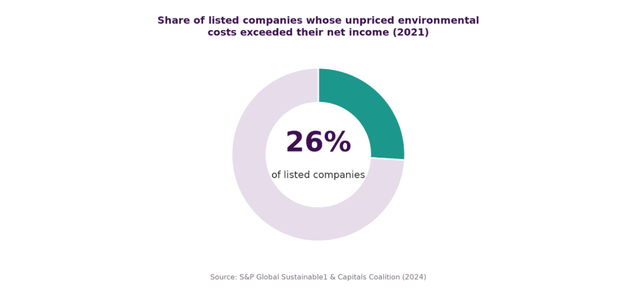 Source: Source: S&P Global, Sustainable1 & Capitals Coalition, Unpriced Environmental Costs (2024).
Put plainly: a meaningful share of reported corporate profit exists only because some costs are quietly passed to society and, for a universal owner, “society” includes the rest of your own portfolio.
What this means in practice
This isn’t an argument for charity; it’s an argument about risk. It reframes stewardship: when a diversified owner votes or engages, the goal isn’t only to improve one company’s returns, but to discourage practices that threaten the value of the whole portfolio and to support those that protect the shared “commons” all investors depend on. Where company and client interests don’t align, the levers are engagement, voting and, at times, supporting sensible policy and regulation.
Why it fits not-for-profit trustees
This thinking fits unusually well with the mandate of charitable and community investors. If your trust deed effectively commits you to investing in perpetuity, you are the ultimate long-term, diversified owner, exactly the investor for whom systemic risks matter most. As one panel framed it, an unwillingness to deal with these issues is, in effect, passing harm on to the next generation. Managing them is simply good, intergenerational risk management and it does not ask you to trade returns for values, but starts from the premise that protecting the health of the whole system is one of the more rational ways to protect long-term returns.
We'd be glad to kōrero about how this long-term investment lens informs our approach and supports resilient outcomes for our clients.
Sources
- RIAA Australian Conference 2026 — author’s notes, including sessions featuring The Shareholder Commons.
- S&P Global, Sustainable1 & Capitals Coalition, Unpriced Environmental Costs: The Top Externalities of the Global Market (2024).
- World Economic Forum — analysis of global GDP dependency on nature.
Prepared by Trust Investments Management Limited (Trust Investments). This article is general information only and is not financial advice; it does not take account of the objectives, financial situation or needs of any particular
Author: Catherine Bodnar - Investment Analyst, Trust Investments